
Car Door Lock Actuator Replacement: Why Your Power Door Locks Stop Working and Who Can Fix Them?

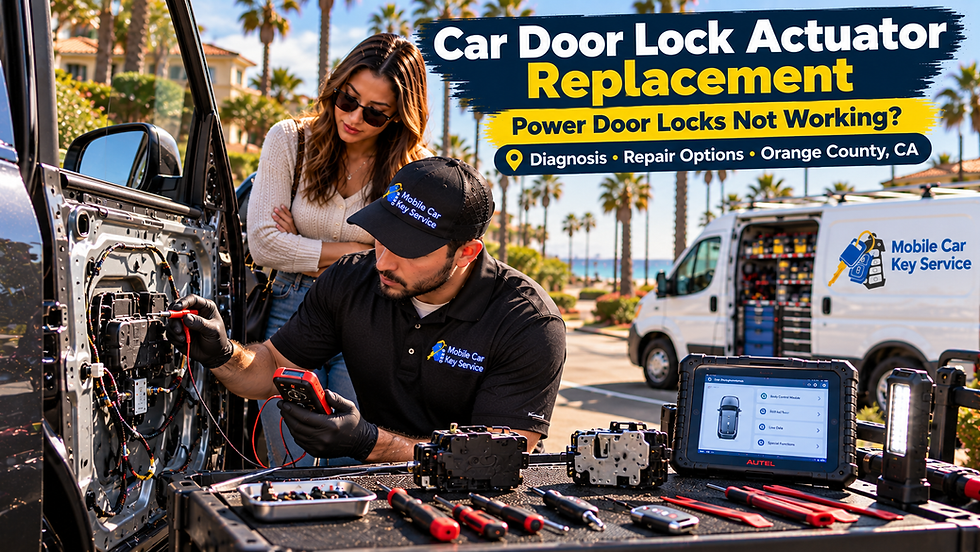
You press the unlock button on your car key fob, hear a faint click, and reach for the driver's door handle.
Nothing happens.
You press the button again. The other doors unlock normally, but the driver's door stays locked.
At first, you assume the remote battery is weak. You try the button on the driver's door, then the key fob again. Still nothing.
Now you're wondering whether the car door lock is broken, whether the key fob needs programming, or whether the problem is hidden somewhere inside the door.
One possible cause is a failing car door lock actuator.
This small electromechanical component helps operate the locking mechanism when you press a remote button or use the vehicle's power door lock controls.
When it fails, you may notice intermittent locking, unusual noises, or a door that refuses to lock or unlock electronically.
But not every power door lock problem is caused by the actuator. A broken wire, faulty switch, damaged latch assembly, or vehicle control-system issue can create similar symptoms.
That's why proper diagnosis matters before replacing parts.
If you're researching car door lock actuator replacement, this guide explains how power door locks work, what causes them to fail, how to distinguish actuator problems from key fob issues, and whether you should call an automotive locksmith or a mechanic.
We'll also discuss repair considerations for drivers in Huntington Beach and throughout Orange County, California.
1. What Is a Car Door Lock Actuator?
A car door lock actuator is a component that converts an electrical command into mechanical movement.
In many vehicles, it contains a small electric motor and gears that move the locking mechanism between locked and unlocked positions.
When you press the unlock button on your key fob, the vehicle receives the remote signal and sends an appropriate command through its electrical control system.
The actuator then moves the locking mechanism.
The design varies by manufacturer.
Some vehicles use a relatively separate actuator.
Others integrate the actuator into a larger door latch assembly.
This distinction matters because some vehicles allow replacement of an individual component, while others require replacing the complete latch-and-actuator unit.
If you're considering car door lock actuator replacement, the first step is identifying the exact system installed in your vehicle.
2. How Do Power Door Locks Work?
Modern power door locks involve several components working together.
These may include:
Key fob or smart key
Remote receiver or vehicle access module
Body control module
Door lock switches
Electrical wiring and connectors
Door lock actuators
Mechanical lock and latch assemblies
When you press a remote button, the vehicle interprets the command and activates the appropriate locking components.
The actuator moves the mechanical mechanism, allowing the door to lock or unlock.
A problem anywhere along this chain may prevent normal operation.
For example, the remote may transmit correctly while a damaged wire prevents the driver's door actuator from receiving power.
Alternatively, the actuator may receive the correct electrical command but fail because its internal motor or gears are worn.
That is why power door lock repair should begin with diagnosis rather than immediate parts replacement.
3. Seven Signs of a Bad Car Door Lock Actuator
A failing actuator can produce several recognizable symptoms.
However, none of these signs confirms actuator failure by itself.
1. One Door Won't Unlock Electronically
You press the remote button, and three doors unlock while one remains locked.
This can indicate a problem affecting the individual door, including its actuator, wiring, or mechanical latch.
2. The Door Locks Intermittently
Sometimes the door responds immediately. Other times, nothing happens.
Intermittent operation can result from a failing motor, damaged connector, wiring fault, or mechanical resistance.
3. You Hear Clicking or Buzzing
An actuator with worn internal gears or a struggling motor may produce unusual noises.
However, sounds alone cannot identify the failed component.
4. The Lock Moves Slowly
A lock indicator that moves sluggishly may indicate increased mechanical resistance or an electrical problem.
5. The Door Won't Lock Using the Interior Switch
If the door fails to respond to both the key fob and the interior switch, the issue may be inside the door or its electrical circuit.
6. The Lock Works Only Occasionally
A failing electrical connection or actuator may cause inconsistent operation.
7. The Door Makes Noise but Doesn't Lock
You may hear the motor operate without the mechanical lock completing its movement.
This can happen when internal gears or linkage components are damaged.
If you notice these symptoms, a professional car door lock repair diagnosis can help identify the actual cause.
4. Why Does Only One Car Door Stop Locking?
When only one door fails, the problem is often localized to that door.
Possible causes include:
Failed actuator motor
Damaged actuator gears
Broken mechanical linkage
Faulty door latch assembly
Corroded electrical connector
Broken wiring near the door hinge
Mechanical obstruction
Door-specific control fault
A common mistake is assuming the key fob needs programming.
If the same remote successfully locks and unlocks the other doors, the remote is clearly communicating with the vehicle.
That does not prove the actuator is defective, but it makes a general remote programming problem less likely.
A technician performing car door lock actuator repair should inspect the affected door and its related electrical and mechanical components.
5. Why Won't Any of the Car Doors Lock or Unlock?
When every power door lock stops responding, the problem may involve a shared electrical or control component.
Possible causes include a weak vehicle battery, blown fuse, failed switch, control module issue, or another electrical fault.
A key fob problem is also possible if the locks operate correctly using the interior controls but not the remote.
This difference is important.
If the locks work from the interior switch, the actuators may be functioning normally.
If neither the remote nor the interior controls operate the locks, additional electrical diagnosis may be necessary.
Before scheduling car door lock replacement, explain whether the problem affects one door or every door.
That information helps narrow the possible causes.
6. Bad Door Lock Actuator vs. Dead Key Fob Battery
A weak key fob battery can make the remote work inconsistently or stop responding.
However, a dead remote battery and a failed actuator are different problems.
Symptom | Possible key fob issue | Possible actuator or door issue |
No doors respond to remote | Yes | Shared vehicle fault also possible |
Interior lock switch works | Supports remote-related diagnosis | Actuator may still be functional |
Only one door fails | Less likely | More likely |
Unusual noise inside one door | Unlikely | Possible |
Mechanical key operates normally | Possible | Possible |
One door locks intermittently | Less likely | Possible |
A simple comparison between remote operation and interior switch operation can provide useful diagnostic information.
However, it should not replace professional testing when the problem remains unclear.
If you're searching for car locksmith near me because the remote isn't working, explain whether the mechanical key and interior lock switches still operate normally.
7. Mechanical Door Lock Cylinder vs. Electronic Door Lock
Actuator
These two components are often confused.
The mechanical lock cylinder is the part that accepts a physical key on vehicles equipped with an exterior keyhole.
The door lock actuator is an electrically operated component that moves the locking mechanism.
They perform related but different functions.
A worn mechanical key or damaged cylinder may prevent manual unlocking.
A failed actuator may prevent electronic locking even when the mechanical key works.
Some vehicles also have electronic latch systems that operate differently from traditional designs.
A qualified automotive locksmith may be appropriate for certain mechanical key and cylinder problems.
Electrical actuator replacement may be better handled by an automotive mechanic or electrical specialist.
Understanding this difference can help you choose the right service provider.
8. Can a Mobile Locksmith Fix a Power Door Lock?
It depends on the problem and the locksmith's capabilities.
Some automotive locksmiths diagnose mechanical lock problems, extract broken keys, service supported lock cylinders, and provide authorized vehicle entry.
Certain providers may also offer limited electrical lock diagnosis.
However, car door lock actuator replacement often involves removing interior door trim, inspecting wiring, testing electrical signals, and replacing an actuator or integrated latch assembly.
Not every mobile locksmith performs these repairs.
For a confirmed electrical actuator failure, an automotive repair shop or qualified auto electrical technician may be the more appropriate choice.
Mobile Car Key Service provides mobile automotive locksmith and car key services throughout Orange County. Customers should contact the business to confirm support for a specific mechanical lock or key-related issue.
Actuator replacement should not be assumed to be an available service without confirmation.
9. When Should You Call an Auto Mechanic?
An automotive mechanic may be the better choice when the problem involves electrical components, door latch assemblies, or vehicle control systems.
Examples include:
A confirmed failed actuator motor
Broken wiring inside the door
A faulty power door lock switch
A defective integrated latch assembly
A vehicle control module problem
Electrical faults affecting multiple doors
An automotive electrical specialist may be particularly useful when the symptoms are intermittent or the cause isn't obvious.
If you're searching for car door lock repair near me, ask whether the provider performs electrical actuator diagnosis and replacement.
This can prevent booking a service that doesn't address the actual problem.
10. Can a Locksmith Help If the Mechanical Key Won't Unlock the Door?
Yes, some mechanical key and lock cylinder problems fall within automotive locksmith work.
Possible causes include a worn key, damaged cylinder, jammed internal components, or broken mechanical linkage.
A qualified locksmith may be able to evaluate supported mechanical lock systems.
However, if the cylinder turns normally but the door remains locked, the problem may involve linkage or latch components.
That could require additional door repair.
When looking for car lock repair near me, explain whether the physical key turns, whether the lock feels stuck, and whether electronic unlocking works.
Those details help distinguish mechanical lock problems from power door lock faults.
11. How Is a Bad Car Door Lock Actuator Diagnosed?
A proper diagnosis begins by confirming the symptoms.
The technician may compare the affected door with the other doors.
They may test the key fob, interior lock switches, and available mechanical key.
Depending on the vehicle, diagnosis can involve checking relevant fuses, inspecting wiring, measuring electrical signals, and evaluating mechanical latch movement.
Some vehicles provide diagnostic information through electronic control modules.
The exact procedures vary.
A technician should confirm whether the actuator is receiving the correct command before concluding that it needs replacement.
Replacing an actuator without checking the wiring can result in an unnecessary repair.
12. What Happens During Car Door Lock Actuator Replacement?
The procedure depends on the vehicle's door design.
In many vehicles, the repair involves gaining access to components inside the door.
A qualified technician may need to remove interior trim, inspect connectors, disconnect the faulty assembly, and install the appropriate replacement.
Some models require replacement of an integrated latch-and-actuator unit.
After installation, the technician should verify that the door locks and unlocks correctly.
They should also check that the door opens, closes, and latches safely.
The repair should follow the manufacturer's service procedures, particularly when door-mounted electrical components or safety systems are involved.
For this reason, car door lock actuator replacement is often best handled by a technician experienced with automotive door assemblies.
13. Can You Repair an Actuator Instead of Replacing It?
Sometimes, but replacement is often the practical option when internal motor or gear damage is confirmed.
An actuator may be part of a sealed or integrated assembly.
Opening or rebuilding it may not be supported by the manufacturer.
However, not every symptom requires replacing the actuator.
A loose connector, damaged wire, or mechanical obstruction may be repairable without replacing the entire unit.
The important question is whether the actuator itself has failed.
A professional diagnosis helps avoid unnecessary parts replacement.
14. How Much Does Car Door Lock Actuator Replacement Cost?
The total car door lock actuator cost varies by vehicle and repair requirements.
Several factors affect pricing.
Vehicle Make and Model
Some vehicles use separate actuators, while others require larger integrated assemblies.
Replacement Part
Original equipment and compatible aftermarket components may have different costs and availability.
Labor
Door trim design and access to the actuator can affect the work involved.
Diagnostic Time
Intermittent electrical faults may require additional testing.
Additional Damage
Broken wiring, damaged linkage, or latch problems may increase the repair scope.
Service Location
Mobile diagnosis or repair, when offered, may include travel charges.
Rather than relying on a universal price estimate, request a vehicle-specific quote that separates diagnosis, parts, labor, and applicable fees.
15. Is a Door Lock Actuator Expensive to Replace?
The answer depends on the vehicle.
Some actuator assemblies are relatively straightforward to access and replace.
Others are integrated into more complex door latch systems.
Labor requirements can also vary considerably.
A repair that involves replacing a simple component may be less involved than one requiring extensive door disassembly or electrical diagnosis.
When comparing estimates, ask whether the quote includes the complete required assembly and functional testing.
The lowest parts price does not necessarily represent the lowest total repair cost.
16. Can a Failing Door Lock Actuator Drain the Car Battery?
Under certain circumstances, an electrical fault associated with the locking system could contribute to abnormal battery drain.
However, a failed actuator does not automatically drain the vehicle battery.
Many actuator failures involve a motor or gear that simply stops functioning.
Other faults, such as a circuit remaining energized or a control module failing to enter its normal low-power state, may create electrical consumption problems.
If the vehicle battery repeatedly becomes discharged, professional electrical diagnosis is appropriate.
Do not assume that replacing a door lock actuator will solve a battery-drain problem without testing.
17. Is It Safe to Drive With a Bad Door Lock Actuator?
The answer depends on how the fault affects the door.
If the door closes and latches securely but cannot be locked electronically, the main concern may be vehicle security.
You may need to use a manufacturer-approved alternative locking method until the problem is repaired.
However, if the door cannot close or latch properly, the situation is more serious.
Do not drive a vehicle with a door that cannot latch securely.
A faulty latch can create a safety risk.
If the problem affects the door's ability to remain closed, arrange appropriate repair before driving.
18. What If the Door Is Stuck Locked?
A door that remains locked can be frustrating, especially when the remote and interior switch both fail.
Avoid forcing the handle or attempting to pry open the door.
Excessive force may damage trim, linkages, weather seals, or electrical components.
If you cannot access the vehicle, a qualified car unlock service near me may be able to provide authorized entry for supported vehicles.
However, unlocking the vehicle does not necessarily repair a failed actuator or latch.
If the door remains mechanically or electrically defective, additional repair may be necessary.
19. What If the Door Won't Stay Locked?
A door that cannot remain locked creates a security concern.
Possible causes include a faulty actuator, damaged latch mechanism, or another locking-system problem.
If the vehicle repeatedly unlocks itself, the issue may involve a control-system command rather than the actuator alone.
Do not assume the problem is simply a bad remote.
If the vehicle cannot be secured, consider parking it in a safe location and arranging professional diagnosis.
20. Can a Door Lock Actuator Fail Without Warning?
Yes.
Some actuators gradually develop symptoms such as slower movement or intermittent operation.
Others may stop working unexpectedly.
Electrical connectors and wiring can also fail without obvious warning.
A door that worked normally yesterday may stop responding today.
If you notice intermittent operation, unusual noises, or delayed locking, arranging diagnosis before complete failure may reduce inconvenience.
21. Does Reprogramming the Key Fob Fix a Bad Actuator?
Generally, no.
Key fob programming addresses electronic key or remote authorization and communication requirements.
A physically failed actuator motor or damaged gear cannot be repaired through key fob programming.
If the remote successfully operates the other doors, reprogramming may be unnecessary.
However, some vehicles have settings or control-system issues that affect locking behavior.
The correct approach is to diagnose the cause rather than automatically replacing or reprogramming the remote.
If you're researching automotive locksmith services, explain which doors respond and whether the interior switch works.
22. What If the Power Locks Work From the Key Fob but Not the Interior Switch?
This symptom can point toward a problem with the interior switch or its related electrical circuit.
If the actuator responds normally to remote commands, it may be functioning correctly.
However, the exact system design varies by vehicle.
A technician may need to inspect the switch, wiring, and control module inputs.
Replacing the actuator without diagnosing the switch could be unnecessary.
23. What If the Interior Switch Works but the Key Fob Doesn't?
If the interior switch operates the locks normally, the actuators are demonstrating that they can respond to at least one command source.
The problem may involve the remote battery, remote electronics, key registration, or vehicle receiver.
Other vehicle-specific causes are possible.
For supported key-related problems, a mobile automotive locksmith may be able to evaluate the remote or replacement key requirements.
If the issue is in the vehicle's receiver or control electronics, an automotive electrical specialist may be needed.
24. How Long Does Car Door Lock Actuator Replacement Take?
There is no universal completion time.
The procedure depends on the vehicle, the failed component, and the accessibility of the assembly.
Some repairs involve relatively straightforward access.
Others require additional trim removal, diagnostic testing, or integrated latch replacement.
Parts availability can also affect scheduling.
A repair shop can provide a more useful estimate after identifying the vehicle and confirming the fault.
25. Should You Replace All Door Lock Actuators at Once?
Usually, actuator replacement should be based on diagnosis rather than assumption.
A failed actuator in one door does not automatically mean the other actuators need replacement.
However, if several doors show similar symptoms, the technician should investigate whether there is a shared electrical or control-system problem.
Replacing every actuator without testing could be expensive and unnecessary.
Ask the repair provider to explain the evidence supporting each recommended replacement.
26. Car Door Lock Problems in Huntington Beach, CA
Huntington Beach drivers use their vehicles for commuting, errands, work, and everyday transportation.
A malfunctioning power door lock can make ordinary activities inconvenient.
The problem may involve the key fob, mechanical lock cylinder, actuator, or vehicle electrical system.
Identifying the correct component is essential.
Mobile Car Key Service provides mobile automotive locksmith and car key services in Huntington Beach.
For supported key-related or mechanical lock concerns, customers can contact the business to discuss available assistance.
For confirmed actuator or wiring faults, an automotive repair specialist may be required.
27. Automotive Locksmith Assistance Across Orange County
Mobile Car Key Service serves Huntington Beach, Anaheim, Santa Ana, Westminster, Buena Park, Garden Grove, and surrounding Orange County communities.
Drivers searching for automotive locksmith near me may need assistance with vehicle keys, replacement remotes, or authorized lockouts.
However, electronic door lock actuator replacement is a different service category from ordinary car key programming.
If you're unsure whether the problem involves the remote or the door mechanism, describe the symptoms clearly.
A provider can help determine whether the issue falls within its service capabilities or requires an automotive repair shop.
28. How to Choose the Right Professional for Car Door Lock Problems
Choosing the correct specialist can save time and reduce unnecessary expenses.
If the mechanical key is damaged or the lock cylinder is jammed, an automotive locksmith may be appropriate.
If the actuator motor, wiring, switch, or integrated latch assembly has failed, an automotive mechanic or electrical specialist may be better equipped.
Before booking, ask:
Does the provider diagnose electronic power door lock problems?
Can they test the actuator and wiring?
Do they replace integrated latch assemblies?
Is diagnostic labor included in the estimate?
Will they test the door after repair?
Do they support your vehicle's exact year, make, and model?
When searching for car door lock repair near me, clear answers to these questions matter more than a low advertised starting price.
29. How Can You Reduce Future Power Door Lock Problems?
Not every actuator failure can be prevented.
However, regular attention to door operation may help identify developing problems.
Avoid repeatedly forcing a stuck mechanical lock.
Address water intrusion or damaged door seals when discovered.
Pay attention to unusual clicking, slow lock movement, and intermittent operation.
If a door becomes difficult to close or latch, have it inspected promptly.
Follow manufacturer recommendations for vehicle maintenance and electrical repairs.
Most importantly, avoid replacing parts based only on symptoms without confirming the cause.
30. Final Thoughts: Who Should Fix Your Power Door Locks?
When your power door locks stop working, the actuator is one possible cause—but not the only one.
A failed motor, damaged gears, broken linkage, faulty switch, wiring issue, or vehicle control-system problem may create similar symptoms.
The right repair begins with accurate diagnosis.
For mechanical key and supported lock cylinder issues, an automotive locksmith may be able to help.
For confirmed electrical actuator failures, an automotive mechanic or electrical specialist may be the better choice.
If you're in Huntington Beach or Orange County and experiencing a car key, remote, or mechanical lock problem, Mobile Car Key Service can discuss available automotive locksmith assistance for supported vehicles.
The goal is to identify the real problem and connect you with the appropriate solution.
Frequently Asked Questions
1. What are the signs of a bad car door lock actuator?
Common signs include intermittent electronic locking, unusual clicking or buzzing, slow lock movement, or one door failing to respond to remote and interior lock commands.
2. How much does car door lock actuator replacement cost?
The cost depends on the vehicle, replacement part, diagnostic work, labor, and whether the actuator is integrated into the latch assembly.
3. Can a locksmith replace a car door lock actuator?
Some providers may offer this service, but many automotive locksmiths focus on keys and mechanical locks. Electrical actuator replacement may require an automotive mechanic or electrical specialist.
4. Why does only one car door refuse to unlock?
Possible causes include a failed actuator, damaged wiring, faulty connector, broken linkage, or latch problem affecting that door.
5. Can a dead key fob battery cause one door not to unlock?
A weak remote battery can affect remote operation, but when the other doors respond normally, a problem localized to the affected door becomes more likely.
6. Can a bad door lock actuator drain the car battery?
Certain electrical faults may contribute to abnormal battery drain, but a failed actuator does not automatically cause battery discharge.
7. Is it safe to drive with a broken door lock actuator?
If the door closes and latches securely, the main concern may be security. If the door cannot latch safely, do not drive until it is repaired.
8. Can key fob programming fix a faulty door lock actuator?
Programming cannot repair a physically failed actuator motor or damaged mechanical components. Proper diagnosis is needed to identify the fault.
9. Should I replace every door lock actuator if one fails?
Not necessarily. Replacement should be based on diagnosis. A failure in one door does not automatically mean the other actuators are defective.
10. Who should I contact for car door lock problems in Orange County?
For key, remote, or mechanical lock concerns, Mobile Car Key Service provides mobile automotive locksmith services for supported vehicles. For confirmed actuator, wiring, or latch assembly faults, contact an appropriate automotive repair specialist.
Need Help With a Car Key or Lock Problem in Orange County?
A malfunctioning door lock can be caused by several different components.
Before replacing an actuator, it's important to determine whether the issue involves the remote, mechanical lock, electrical wiring, or latch assembly.
Mobile Car Key Service provides mobile automotive locksmith and car key services throughout Huntington Beach and Orange County.
For supported key-related or mechanical lock concerns, contact the business with your vehicle's year, make, model, and symptoms to discuss available assistance.
Call: +1 878-786-6873
Website: https://www.mobilecarkeyservice.com/
Mobile Car Key Service
Address: 7821 Seabreeze Dr, Huntington Beach, CA 92648
Phone: +1 878-786-6873
Service Area: Orange County, California
Hours: Open 24 Hours
Serving Orange County, California: Mobile Car Key Service provides mobile automotive locksmith and car key services throughout Orange County, including Huntington Beach, Anaheim, Santa Ana, Westminster, Buena Park, Garden Grove, and surrounding communities.
See Our Recent Customer Reviews: Visit the Mobile Car Key Service Google Business Profile to see recent customer reviews and learn more about customers' experiences with our mobile automotive key services.


Comments