
Car Key Fob Won’t Work After Being Dropped? What Orange County Drivers Should Check Before Replacing It

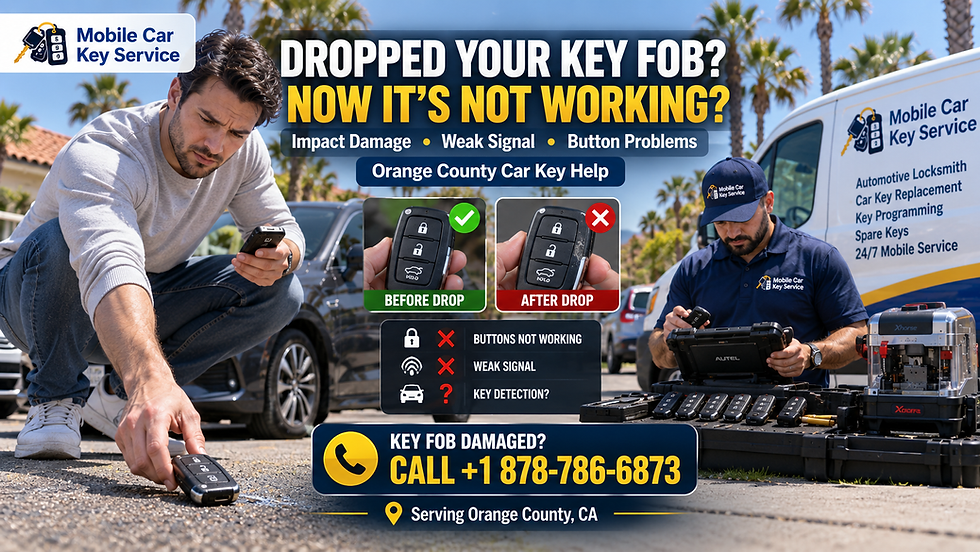
You drop your car key fob onto the driveway.
It hits the concrete hard.
You pick it up, look at the case, and everything seems normal. There may not even be a visible crack.
Then you press UNLOCK.
Nothing.
You press it again.
Still nothing.
Or maybe the doors unlock, but only after several presses. Perhaps the vehicle starts but the remote buttons no longer work. Maybe your push-to-start vehicle suddenly displays a key-related warning. In other cases, the fob works from a few feet away but no longer has its normal range.
When a problem begins immediately after an impact, it is reasonable to ask:
“Did dropping my key fob actually damage it?”
The answer is: it can.
A modern car key fob is a small electronic device containing components that can be affected by physical impact. At the same time, not every dropped fob requires replacement. Sometimes the impact shifts the battery, affects a contact, separates the housing, or reveals a problem that can be addressed without replacing the entire key.
The important thing is to identify what changed after the drop.
For supported vehicles, Mobile Car Key Service provides mobile automotive key services throughout Orange County, California, including key fob replacement, smart key replacement, car key programming, key fob programming, transponder key programming, spare car keys, and related automotive key services.
Dropped your key fob and now it isn't working correctly? Call +1 878-786-6873.
1. Can Dropping a Car Key Fob Really Damage It?
Yes, particularly after a hard impact.
Think about what a modern key fob may contain:
A battery
Battery contacts
Circuit board
Remote-control electronics
Physical button mechanisms
Transponder or smart-key components, depending on the design
Emergency mechanical key
Plastic housing
Internal clips and supports
All of those components are packed into a device small enough to carry in your pocket.
The exterior housing provides protection, but it cannot make the electronics completely immune to impact.
A key dropped from a kitchen counter onto carpet is very different from one dropped several feet onto concrete.
Likewise, one impact may cause no noticeable problem while another lands at exactly the wrong angle.
2. The Timing of the Failure Is an Important Clue
Imagine your key worked normally all morning.
You parked outside a business in Huntington Beach.
As you stepped out, the key slipped from your hand and landed hard on the pavement.
Immediately afterward:
UNLOCK stops responding.
That timeline matters.
It doesn't prove exactly which component was damaged, but the sudden change gives you useful diagnostic information.
Compare that with a remote that has gradually lost range over six months. The symptoms may eventually look similar, but the history is different.
When troubleshooting a dropped car key fob not working, remember what happened immediately before the failure.
3. First Question: What Exactly Stopped Working?
Don't simply classify the entire key as "broken."
Test each relevant function.
Depending on your vehicle, check:
LOCK
Does it lock the vehicle?
UNLOCK
Does it unlock the vehicle?
Trunk or Hatch
Does the applicable button respond?
Panic Button
Does it operate according to the vehicle's normal procedure?
Passive Entry
If equipped, does the vehicle recognize the smart key when you approach or touch the door handle?
Engine Start
Does the vehicle recognize the key and allow normal starting?
The pattern matters.
For example:
LOCK ✕UNLOCK ✕START ✓
is different from:
LOCK ✕UNLOCK ✕START ✕
And both are different from:
LOCK ✓UNLOCK ✕START ✓
4. Dropped Key Fob Is Completely Dead
One of the more alarming scenarios is when the fob appears completely unresponsive immediately after hitting a hard surface.
You press every button.
Nothing happens.
Before searching for key fob replacement near me, inspect the simplest possibilities first.
A hard impact may have affected:
Battery position
Battery contact
Housing alignment
Internal components
Button mechanisms
If the case has partially opened, don't repeatedly squeeze, bend, or slam it back together without checking how the components are positioned.
A small physical problem can become a larger one if the fob is handled aggressively.
5. Check Whether the Battery Shifted During the Drop
A key fob battery must maintain appropriate contact with its terminals.
A hard impact can potentially disturb that contact.
If your fob design allows safe battery inspection, check whether:
The battery is seated correctly
The battery has shifted
The battery cover is secure
Contacts appear obviously displaced
The housing closes correctly
If you remove the battery, pay attention to its orientation before reinstalling it.
Do not force battery contacts or bend small metal components unless you know what you are doing.
They can be delicate
.
6. Don't Assume the Battery Is Good Just Because It Worked Before the Drop
Suppose the battery was already near the end of its useful life.
Before the drop, the fob still worked—but its range had become weaker.
Then the key hits the pavement and stops responding.
The impact may be the obvious event, but the battery condition is still worth checking.
If the battery is old or its condition is uncertain, replacing it with the correct specified battery can be a reasonable basic troubleshooting step.
But if a correct fresh battery does not restore operation, don't keep installing battery after battery.
Move on to the next clues.
7. Inspect the Battery Contacts Carefully
The battery itself is only part of the power connection.
Look at the contacts that hold or touch it.
Possible warning signs include:
Contact no longer touching the battery properly
Contact visibly bent
Battery sitting loosely
Battery moving inside the housing
Housing not holding components securely
Avoid aggressive DIY bending.
A small contact can be damaged further if excessive force is applied.
If you're unsure, professional evaluation may be safer than experimenting with the only key you have.
8. Inspect the Exterior Housing After the Impact
Look at the entire key under good lighting.
Check:
Front cover
Back cover
Battery cover
Button area
Seams
Corners
Key-ring attachment
Emergency blade
Any removable components
You're looking for changes such as:
New crack
Separated seam
Loose cover
Missing piece
Button sitting differently
Housing that flexes
Rattling inside
Emergency blade that no longer sits properly
Even a small crack can matter because the housing helps hold internal parts in their intended positions.
9. The Case Looks Perfect—Can the Inside Still Be Damaged?
Yes.
This is one reason a dropped key can be confusing.
The exterior shell may show almost no evidence of impact while an internal component has still been affected.
You might see:
Housing looks normal ✓
Battery is fresh ✓
Remote no longer works ✕
A clean exterior therefore does not guarantee that everything inside survived the impact.
The next step is to look at the behavior of the key rather than judging it only by appearance.
10. Does the Key Rattle After Being Dropped?
A new rattling sound deserves attention.
Gently moving the key may reveal that something inside is loose.
Do not shake it violently to "test" the noise.
If a component has already come loose, repeated shaking is unlikely to help.
Compare the sound with a spare key if you have one.
A loose internal component combined with immediate post-impact failure is useful information to provide when seeking car key fob repair near me.
11. What If Only One Button Stopped Working?
Suppose the fob lands on one edge.
Afterward:
LOCK ✓UNLOCK ✕TRUNK ✓START ✓
That pattern is much more specific than complete failure.
Look at the UNLOCK button.
Does it:
Feel softer than before?
Feel harder?
Sit lower?
Stick?
Require pressure at an angle?
Have no normal tactile response?
If one button stops functioning immediately after an impact while the other functions remain normal, the affected button or its associated internal mechanism deserves attention.
Our guide on car key fob buttons not working covers button-specific problems in more detail.
12. What If All Remote Buttons Stop Working but the Car Still Starts?
This is an important scenario.
After the drop:
LOCK ✕UNLOCK ✕TRUNK ✕CAR STARTS ✓
Drivers sometimes assume:
“If the car starts, the key can't be damaged.”
That conclusion is too broad.
Depending on the vehicle and key system, remote door-control functions and engine-start authorization do not necessarily depend on exactly the same components or process.
A key may therefore retain starting capability while its remote-control functionality has been affected.
We cover this specific symptom in Car Key Fob Starts the Car but Won’t Lock or Unlock the Doors.
13. What If the Remote Works but the Car Won’t Start?
Now reverse the symptom:
LOCK ✓UNLOCK ✓START ✕
This requires a different diagnostic approach.
The fact that the remote buttons work does not necessarily prove that every part of the key involved in vehicle-start authorization is functioning correctly.
Likewise, a vehicle that doesn't start can have causes unrelated to the key.
Pay attention to any legitimate dashboard message or key-related warning and compare with a spare authorized key if available.
For this symptom, see Car Key Fob Unlocks the Car but Won’t Start It.
14. Push-to-Start Says “Key Not Detected” After the Drop
This can be particularly concerning.
Before the drop, your smart key worked normally.
Afterward, your push-to-start vehicle displays something similar to:
KEY NOT DETECTED
or another manufacturer-specific key warning.
First, don't assume the key is the only possible cause.
Check:
Fob battery
Battery installation
Spare key behavior
Whether the warning occurs consistently
Whether the key works using any manufacturer-provided backup/emergency recognition procedure described in the owner's manual
If the problem started immediately after impact and a spare works normally, the damaged key deserves closer attention.
Our dedicated guide on Push-to-Start Says “Key Not Detected” explains this symptom in more detail.
15. Don't Keep Hitting the Key to Make It Work
Some people instinctively tap an electronic device when it stops working.
That is a bad troubleshooting strategy for a car key.
If dropping the key appears to have caused the problem, intentionally hitting it again can create additional damage.
Avoid:
Hitting it against your hand
Tapping it on a table
Dropping it again intentionally
Twisting the housing
Bending the circuit board
Forcing the battery contacts
If pressure or movement temporarily changes the behavior, treat that as a diagnostic clue—not a repair method.
16. Does Squeezing the Key Fob Make It Work?
This is an interesting symptom.
Normally:
UNLOCK → nothing
But when you squeeze the housing:
UNLOCK → works
Then you release pressure:
UNLOCK → stops working again
This doesn't identify the exact failed component, but it suggests that physical pressure is changing something inside the fob.
Possible areas to investigate may include:
Battery contact
Housing fit
Internal connection
Button alignment
Impact-related electronic damage
Do not tape or clamp the fob tightly as a permanent repair.
If squeezing changes operation, mention that symptom when requesting professional service.
17. Does the Key Fob Now Work Only From Very Close to the Car?
Maybe the remote isn't completely dead.
Before the drop, it worked from a normal distance.
After the drop, you must stand almost beside the vehicle.
For example:
20 feet away → ✕
10 feet away → ✕
Beside vehicle → ✓
That points toward a reduced-range problem rather than complete button failure.
Check the battery first.
If the battery is correct and fresh but the range remains dramatically reduced after the impact, further key-fob evaluation may be appropriate.
See our detailed guide on Car Key Fob Only Works Close to the Car.
18. What If the Dropped Key Works Intermittently?
Impact-related problems do not always produce complete failure.
You may experience:
First press → nothing
Second press → works
Third press → nothing
Then it works normally for an hour.
Later, it fails again.
When this starts immediately after dropping the fob, record the pattern.
Check whether operation changes when:
You move the key
You press a specific area
Temperature changes
You stand closer to the vehicle
You install a fresh battery
Our Car Key Fob Works Intermittently guide covers intermittent behavior more broadly.
19. Test Your Spare Key Before Buying Anything
If you have another authorized key, this is one of the most valuable tests you can perform.
Imagine:
Dropped Primary Key
LOCK ✕
UNLOCK ✕
START sometimes ✕
Spare Key
LOCK ✓
UNLOCK ✓
START ✓
Test both under similar conditions.
If the spare repeatedly works normally while the dropped key consistently fails, that comparison provides useful evidence that the problem follows the dropped key.
Now consider another pattern:
Dropped Primary Key
Remote ✕
Spare Key
Remote ✕
If both show the same symptom, especially if the spare was never dropped, don't automatically assume impact damage explains everything.
20. Why a Spare Key Is So Valuable During Diagnosis
A spare isn't only for the day you lose your main key.
It gives you a control for comparison.
You can compare:
Remote range
LOCK operation
UNLOCK operation
Trunk operation
Passive entry
Start authorization
Dashboard behavior
Without a second key, it can be harder to determine whether the problem follows the key or is associated with the vehicle.
If you currently have only one authorized key, our Spare Car Key Near Me in Orange County guide explains why creating a backup before an emergency can be useful.
21. What If the Key Fob Case Cracked Open?
A hard impact can separate the housing.
If the case opens, first make sure you don't lose small components.
Depending on the design, the key may contain:
Battery
Circuit board
Rubber button pad
Emergency blade
Other internal components
Do not assume you can throw away the broken case and move only the obvious circuit board into a random replacement shell.
Key designs vary, and important components may not always be obvious.
If you're uncertain about the construction, keep every original component together.
22. Can You Just Replace the Plastic Shell?
Sometimes physical housing damage can be addressed separately from electronic failure.
For example:
The case cracks.
The electronics continue functioning normally.
All buttons work.
The vehicle starts normally.
In that situation, an appropriate housing solution may be worth evaluating.
But a shell replacement cannot repair electronics damaged by the impact.
If:
Case cracked ✕
and
Remote electronics also failed ✕
you may be dealing with more than a cosmetic problem.
23. What If the Emergency Key Blade Is Damaged?
Many smart keys include a removable mechanical emergency blade.
A hard impact can potentially damage:
Blade
Blade holder
Release mechanism
Housing around the blade
If the blade is bent, cracked, or no longer seats properly, avoid forcing it into a vehicle lock.
A damaged blade can create a second problem if it becomes stuck or breaks inside the lock cylinder.
For applicable keys, automotive key cutting may be part of a replacement-key solution.
24. Can the Circuit Board Be Damaged Without Looking Broken?
Yes.
Electronic damage is not always visually obvious.
A board can look normal to an untrained eye while still having a failed connection or component.
Conversely, seeing something that looks unusual does not automatically mean it is damaged.
This is why randomly poking, scraping, soldering, or bending internal electronics is risky.
If you're searching for broken key fob repair or car key fob repair near me, the objective should be accurate evaluation—not experimenting on the only key that starts your vehicle.
25. Avoid DIY Soldering Unless You Know Exactly What You're Repairing
Online videos can make electronic repairs look easy.
But automotive key electronics can be small and delicate.
Poor soldering technique can:
Overheat components
Bridge electrical contacts
Lift circuit-board pads
Damage switches
Create additional faults
If you have proper electronics experience, that's different.
But if this is your only authorized smart key, it is usually a poor device on which to learn microsoldering.
26. Could Dropping the Fob Cause a Programming Problem?
This requires careful wording.
A physical impact does not automatically mean that the vehicle suddenly needs key fob programming.
If the problem is:
Broken button
Loose battery
Damaged battery contact
Cracked board
Failed electronic component
programming does not physically repair those problems.
Programming becomes relevant when the vehicle/key situation actually requires electronic authorization, such as when an appropriate replacement key needs to be registered for a supported vehicle.
Don't confuse electronic hardware damage with programming.
27. When Is Car Key Programming Near Me Relevant?
Suppose the dropped smart key is damaged beyond practical use.
You obtain a compatible replacement.
That replacement must be authorized to the vehicle according to its system.
Now car key programming near me or key fob programming near me becomes commercially relevant.
Depending on the vehicle, replacement may involve:
Compatible key identification
Applicable key programming
Smart-key registration
Transponder programming
Emergency blade cutting
Functional testing
For a deeper explanation, see our Car Key Programming Near Me in Orange County.
28. Don't Order a Replacement Based Only on the Shape of Your Old Fob
This mistake can waste both time and money.
You search online.
You find a fob that looks identical.
Same shape.
Same number of buttons.
Same basic layout.
You buy it.
Then discover it is not appropriate for your exact vehicle.
Appearance alone does not establish compatibility.
When considering a damaged car key fob replacement, confirm the correct replacement for the specific:
Year
Make
Model
Key system
Vehicle configuration where relevant
A cheap incompatible key is not a useful replacement.
29. What Information Should You Gather Before Calling a Locksmith?
If the basic checks don't solve the problem and you start searching for an automotive locksmith near me, prepare useful information.
Have your:
Vehicle year
Make
Model
Key type
Push-to-start or keyed ignition
Number of available keys
Exact symptoms
Timeline of the drop
Battery-replacement status
Then describe the problem specifically.
Instead of:
“My car key doesn't work.”
say:
“I dropped my smart key onto concrete. Since then, LOCK and UNLOCK don't work, but the car still starts. I replaced the battery and my spare key works normally.”
That description provides far more diagnostic value.
30. When Should You Stop Troubleshooting and Get Professional Help?
Basic inspection is reasonable.
Repeated experimentation isn't always helpful.
Consider professional car key fob repair near me, key fob replacement near me, or automotive-key evaluation when:
A fresh correct battery makes no difference
Housing is seriously damaged
Fob rattles internally after the drop
Multiple buttons suddenly fail
Vehicle intermittently recognizes the key
Key range becomes dramatically shorter
Fob works only when squeezed
Emergency blade is damaged
Spare works normally while dropped key does not
The damaged fob is your only key
Reliability continues getting worse
The more critical the key is to your daily transportation, the less attractive repeated DIY experimentation becomes.
31. Only One Key? Be More Careful
This deserves special attention.
Imagine your only smart key falls onto concrete.
Afterward:
Car starts ✓
UNLOCK works sometimes
LOCK requires several presses
Housing has a new crack
Technically, you can still drive.
But you no longer have a fully dependable key.
If that fob deteriorates further, gets lost, or stops being recognized, you have no backup.
For someone with only one key, considering a spare car key near me before complete failure can be a sensible preventive decision.
32. Don't Wait for a Damaged Key to Become an All-Keys-Lost Situation
There is an important difference between:
One damaged key + one working spare
and:
No usable keys at all.
If your only key is showing clear signs of impact damage, delaying indefinitely can increase inconvenience if it eventually becomes unusable.
Depending on the vehicle, making another key while a working authorized key remains may also affect the service process.
The exact procedure varies, but having a dependable backup is generally useful.
33. Orange County Example: Key Dropped in a Parking Lot
Imagine a driver in Anaheim getting out of an SUV.
The smart key falls onto asphalt.
Before the impact:
Everything worked normally.
Afterward:
LOCK ✕
UNLOCK works occasionally
Vehicle still starts
A fresh battery does not change anything.
The spare works perfectly.
That sequence gives you a strong reason to investigate the dropped key rather than immediately assuming a vehicle-wide remote-entry problem.
34. Huntington Beach Example: Fob Falls Onto a Driveway
A Huntington Beach driver drops the only key onto a concrete driveway.
The housing partially separates.
The driver snaps it back together.
Now the remote works only when standing next to the vehicle.
The vehicle still starts normally.
This is not complete key failure—but the change in remote range immediately after physical impact is worth investigating.
If you're seeing reduced range specifically, our key fob only works close to the car guide provides additional troubleshooting.
35. Santa Ana Example: Drop Followed by “Key Not Detected”
A Santa Ana driver has a push-to-start vehicle.
The primary smart key falls hard onto pavement.
Immediately afterward, the vehicle becomes inconsistent about recognizing it.
The spare key works normally.
A correct fresh battery in the dropped key does not resolve the issue.
In that situation, continuing to depend on the damaged primary key may not be a good long-term strategy.
Professional evaluation can help determine whether smart key replacement near me and applicable programming are appropriate.
36. What Not to Do After Dropping Your Key Fob
If your key stops working after impact, avoid making the situation worse.
Don't repeatedly drop or hit it.
A second impact is not a repair.
Don't force the housing.
Small clips and internal components can break.
Don't bend battery contacts aggressively.
They may snap or lose proper tension.
Don't insert a damaged emergency blade into the lock.
A broken blade can create a lock-cylinder problem.
Don't spray random cleaners into the electronics.
Automotive electronics and household chemicals are not a good combination.
Don't assume programming fixes physical damage.
Programming cannot rebuild broken hardware.
Don't discard original components.
If the housing opens, keep the original pieces together until you know what is required.
37. The Best First-Day Checklist After Dropping a Key Fob
If your key fob is not working after being dropped, use this sequence:
1. Inspect the housing.
Look for cracks, separation, loose pieces, and button damage.
2. Test every key function.
LOCK, UNLOCK, trunk, passive entry, and starting where applicable.
3. Check the battery.
Confirm correct type, orientation, seating, and contact.
4. Try a correct fresh battery if appropriate.
Don't assume the existing battery is healthy.
5. Test your spare key.
Compare both under similar conditions.
6. Check remote range.
Determine whether the fob is completely dead or simply weaker.
7. Pay attention to intermittent behavior.
Note whether movement or pressure changes operation.
8. Check vehicle recognition.
For smart-key systems, note any relevant key warning.
9. Avoid aggressive DIY repairs.
Don't turn partial failure into total failure.
10. Consider professional evaluation if reliability doesn't return.
Especially if the damaged fob is your only authorized key.
Dropped Your Car Key Fob? Follow the Symptoms Before Replacing It
A key fob hitting concrete does not automatically mean you need a new one.
But when the problem starts immediately after the drop, you should not ignore that timeline either.
The best approach is systematic.
Ask:
Did every function stop?
Did only one button fail?
Does the vehicle still start?
Did the remote range become shorter?
Does the fob work intermittently?
Did the housing crack?
Did the battery shift?
Does squeezing the case change the behavior?
Does your spare key work normally?
Those answers can help distinguish a simple battery/contact issue from physical button damage, internal electronic failure, or another key/vehicle problem.
For supported vehicles, Mobile Car Key Service provides mobile automotive key services throughout Orange County, California, including key fob replacement, smart key replacement, car key replacement, car key programming, key fob programming, transponder key programming, spare car keys, and automotive key cutting.
Dropped Your Key Fob and Now It’s Unreliable?
Call Mobile Car Key Service: +1 878-786-6873
Frequently Asked Questions
1. Can dropping a car key fob make it stop working?
Yes. A hard impact can potentially affect the battery position, battery contacts, housing, buttons, or internal electronic components. The exact damage depends on the key and how it landed.
2. Why did my key fob stop working immediately after I dropped it?
The impact may have shifted the battery, affected a contact, damaged a button or housing component, or caused internal electronic damage. Start by checking the battery, housing, individual functions, and an authorized spare key if available.
3. Can a key fob still start the car after being damaged in a drop?
Depending on the vehicle and key system, yes. The key may retain vehicle-start authorization while remote LOCK or UNLOCK functions are affected.
4. Why does my dropped key fob work only when I squeeze it?
If pressure on the housing changes the fob's behavior, it may indicate that physical movement is affecting a battery contact, button, housing alignment, or another internal connection. Avoid treating squeezing as a permanent repair.
5. Can dropping a key fob reduce its remote range?
It can. If range became significantly shorter immediately after an impact, first check the battery and compare the fob with a working spare. If a fresh battery does not restore normal range, further evaluation may be appropriate.
6. Can a dropped key fob cause a “Key Not Detected” warning?
A key that becomes unreliable after impact may be associated with key-recognition symptoms on some vehicles. However, “Key Not Detected” can have multiple causes, so the drop alone should not be treated as proof of the exact failure.
7. Should I replace the battery after dropping my key fob?
Checking the battery, its orientation, seating, and contacts is a sensible first step. If the battery is old or uncertain, testing the correct fresh battery may help rule out a simple power issue.
8. Can a cracked key fob case be replaced without replacing the electronics?
In some key designs, an appropriate replacement housing may be possible when the electronics remain fully functional. However, replacing the shell will not repair internal electronic damage caused by the impact.
9. Does a dropped key fob need to be reprogrammed?
Not automatically. Programming does not repair physical damage. It becomes relevant when the vehicle/key system requires programming or when an appropriate replacement electronic key needs authorization.
10. Can an automotive locksmith replace a damaged key fob?
For many supported vehicles, an automotive locksmith may be able to provide an appropriate replacement key fob or smart key and perform applicable programming and key cutting.
11. Can a mobile locksmith program a replacement key at my vehicle?
For many supported vehicles and accessible locations, applicable automotive key programming may be performed through mobile service at the vehicle. Availability depends on the vehicle and key system.
12. How much does it cost to replace a damaged key fob in Orange County?
Cost varies according to the vehicle year, make, model, key type, replacement hardware, programming requirements, key cutting, available working keys, and other vehicle-specific factors.
13. What if my spare key works but the dropped key doesn't?
If the spare consistently operates normally under the same conditions while the dropped key does not, that provides useful evidence that the problem may be associated with the dropped key.
14. Should I keep using a dropped key fob if it still works sometimes?
An intermittently functioning key may become inconvenient or unreliable. If symptoms began after impact and continue or worsen, professional evaluation can help determine whether repair or replacement is appropriate.
15. Should I make a spare if the damaged fob is my only car key?
A dependable spare can provide valuable backup if your only key is already showing signs of damage or unreliable operation. The exact replacement and programming process depends on the vehicle.
Dropped Your Key Fob? Repair or Replace Based on the Actual Damage
A dropped car key can create anything from a harmless scratch to a serious electronic problem.
That is why the correct response is not automatically:
“Buy another key.”
Start with the evidence.
If the battery simply shifted and reseating it restores completely normal operation, replacement may not be necessary.
If the case is cracked but every electronic function remains reliable, the housing may deserve attention.
If one button stopped working after the impact, investigate the button-specific problem.
If remote range suddenly collapsed, compare the battery and spare key.
If the vehicle no longer consistently recognizes the smart key, the situation deserves more attention.
And if a fresh battery makes no difference while a spare key works perfectly, the dropped key itself becomes a much stronger suspect.
For drivers searching car key fob repair near me, key fob replacement near me, damaged car key fob replacement, smart key replacement near me, key fob programming near me, car key programming near me, transponder key programming near me, replacement car key near me, spare car key near me, automotive locksmith near me, mobile car locksmith near me, mobile automotive locksmith Orange County, or car key replacement Orange County, the right service depends on the actual diagnosis.
Don't pay for programming to solve broken hardware.
Don't replace a complete electronic key just because its housing has a cosmetic scratch.
And don't ignore a progressively failing only key simply because it still worked this morning.
Need Help With a Dropped or Damaged Car Key Fob in Orange County?
For supported vehicles, Mobile Car Key Service provides mobile automotive key services throughout Orange County, California.
Services may include:
Car key fob replacement
Smart key replacement
Car key replacement
Key fob programming
Car key programming
Transponder key programming
Spare car keys
Automotive key cutting
Related mobile automotive key services
Call Mobile Car Key Service: +1 878-786-6873
Mobile Car Key Service
Mobile Car Key Service
Address: 7821 Seabreeze Dr, Huntington Beach, CA 92648
Phone: +1 878-786-6873
Service Area: Orange County, California
Hours: Open 24 Hours
Serving Orange County, California: Mobile Car Key Service provides mobile automotive locksmith and car key services throughout Huntington Beach, Anaheim, Santa Ana, Westminster, Buena Park, Garden Grove, and surrounding Orange County communities for supported vehicles.
See Our Recent Customer Reviews: Visit the Mobile Car Key Service Google Business Profile to see recent customer reviews and learn about customer experiences with our mobile automotive key services throughout Orange County, California.


Comments